The family move to Straffan Lodge, near Celbridge, Kildare.
Very early in his life, Bacon finds his homosexuality impairs his relationship with his family. He is later to say that his first sexual experience was with stable boys. In addition, he suffers from asthma and is allergic to dogs and horses, which his father sees as a weakness.
Lionel Fletcher, rector of the Church of Ireland, becomes Bacon’s tutor.
1922
The Bacons move to Linton Hall, Herefordshire, England.
1924
Francis is sent to Dean Close School, Cheltenham, Gloucestershire. He is to remain there until 1926, while his family lives in Prescott House in the nearby village of Gotherington.
Dean Close School, Cheltenham
1926
The Bacon family return to live in Ireland at Straffan Lodge.
Bacon is later to claim that he then runs away from home to go to Paris, but is brought back by his parents.
He is subsequently thrown out by his father and settles in London. With an allowance of £3 a week from his mother, he leads a bohemian life, taking on a series of odd jobs.
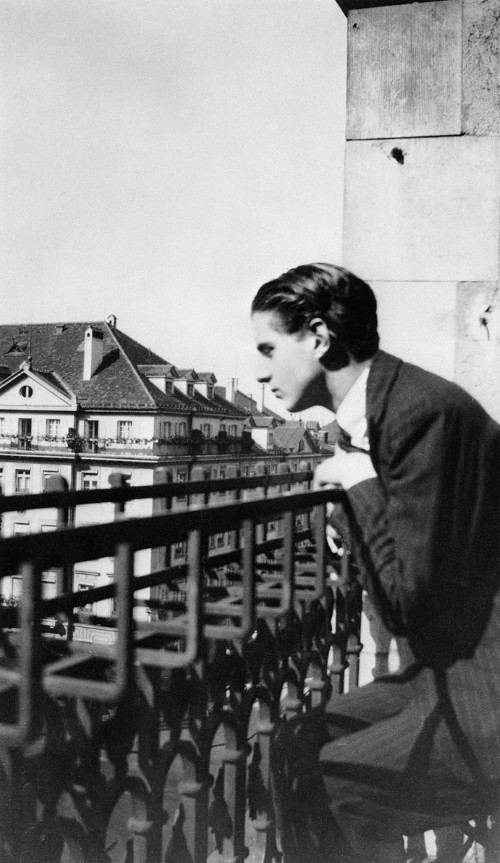
Francis Bacon, London, mid 1920s
1927
On 22 February, Francis’ twelve-year-old brother Edward dies of measles and suffocative catarrh.
In early spring, Eddy Bacon sends Francis to Berlin with a relative, Highat Cecil Harcourt-Smith. In these years, Berlin is an extravagant and exciting city, and also a notorious place for homosexual adventures. They stay at the Hotel Adlon, where, according to Francis Bacon, his chaperone seduces and then abandons him.
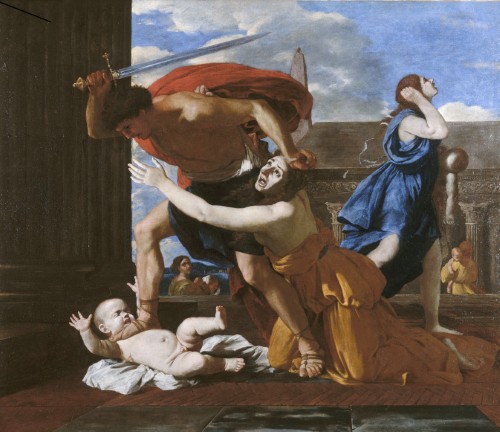
In late spring, Francis Bacon arrives in Paris. There he meets Yvonne Bocquentin, who decides to take him under her wing and offers him a room in her house near Chantilly. She teaches him French and introduces him to the Parisian art scene. During his stay, he sees Poussin’s Massacre of the Innocents (c. 1628 – 1629) at the Musée Condé in Chantilly.
Over the summer, he visits an exhibition by Pablo Picasso at Paul Rosenberg’s Paris gallery at 21 rue La Boétie. The Spanish artist’s work catalyses his vocation as a painter.
In the autumn, Bacon moves to the Hotel Delambre in Montparnasse.
The Bocquentin family in front of their house,1920s
Galerie Paul Rosenberg, Paris
Nicolas Poussin, The Massacre of the Innocents, c. 1628-29, Musée Condé, Chantilly
1928
In September, Bacon’s grandmother dies.
1929
Bacon moves to 6 Relton Mews, Knightsbridge, London.
On 12 July, Bacon travels to Paris and meets Eric Allden on the ferry from Dover to Calais. He tells Allden that he is opening an ultramodern furniture shop in London and is going to Paris to buy furniture. He has just begun a career as a designer of furniture and rugs. Allden is to become Bacon’s lover and chief patron until the early 1930s, and ends up owning several rugs (produced by the Wilton Royal Carpet Factory in England), a painted wood screen, and several early works (a watercolour, a gouache and an oil painting) by Bacon.
On 31 August, Bacon and Allden stop off in Dublin on the way to a holiday in Galway. They stay in a cottage in Renvyle, while Bacon’s family stay in nearby Bunnaboghee. Francis turns one of the cottage’s two bedrooms into a studio.
During their three-week stay, Allden regularly spends time with Bacon’s parents. Jessie Lightfoot joins them. They all frequently dine together in Bunnaboghee or picnic on the beach.
On 28 October, Bacon, Allden and Jessie Lightfoot rent a maisonette at 54 Vincent Square, Pimlico, for ten weeks.
Bacon paints ‘Watercolour’, his earliest surviving painting.
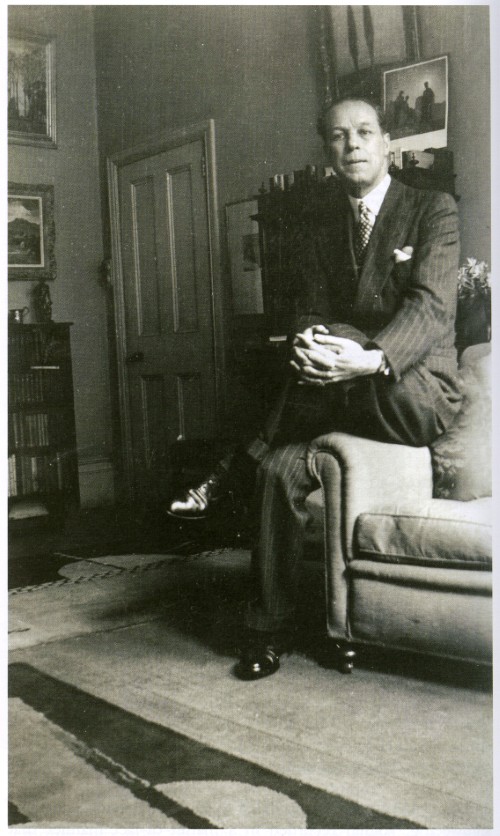
Eric Allden. c. 1935
Francis Bacon, Watercolour, 1929, watercolour, gouache, pencil and black ink on paper, MB Art Collection