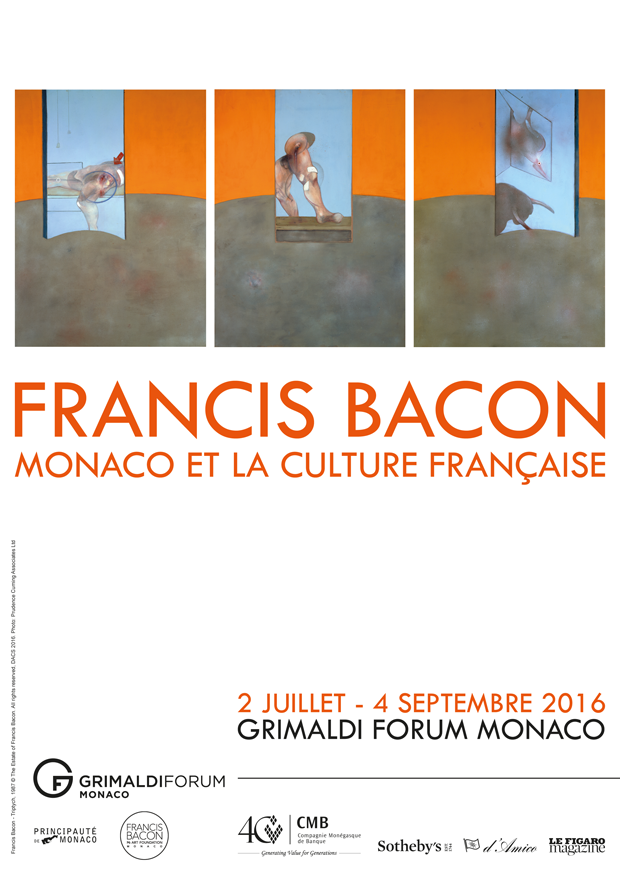
For its 2016 summer exhibition, which ran from 2 July to 4 September, the Grimaldi Forum Monaco chose the theme ‘Francis Bacon, Monaco and French Culture’. The exhibition was curated by Martin Harrison, the author of Francis Bacon: Catalogue Raisonné. It showcased over sixty of Bacon’s works and was mounted in association with The Estate of Francis Bacon, based in London, and the Monaco-based Francis Bacon MB Art Foundation, which supported the exhibition by lending three paintings and a series of photographs and suggested Martin Harrison should curate it. The Foundation also brought out a book entitled Francis Bacon, France and Monaco, jointly published with Albin Michel, to mark the occasion.
Visitors were invited to consider Francis Bacon from a new angle: the influence of French culture and his time in Monaco on his work. Major triptychs, some of the artist’s most important paintings and less well-known works that referred directly or indirectly to France and Monaco were grouped by theme. An unusual feature of the exhibition was the way it made connections with seminal works by great artists who inspired Francis Bacon including Alberto Giacometti, Fernand Léger, Jean Lurçat, Henri Michaux, Chaïm Soutine and Henri de Toulouse-Lautrec.
The artworks on display came from both public and private collections and were chosen to show the full eloquence and power of this giant among artists. Major institutions that lent paintings for the exhibition included Tate Britain and the Arts Council Collection in London, the Art Gallery of New South Wales in Sydney and the Centre Pompidou in Paris.
Francis Bacon steeped himself in French culture, beginning with his first trip to Paris in the late 1920s. In the spring of 1927, aged seventeen, he stayed with the Bocquentin family in Chantilly. They took him under their wing and taught him French. It was also in 1927 that he encountered Picasso’s works when visiting an exhibition at the Paul Rosenberg Gallery and was impelled to become an artist.
After selling his picture Painting 1946 to Erica Brausen, who was to become his art dealer two years later, Bacon left London for the Principality of Monaco in July 1946 and lived there until the early 1950s. It was there that he painted his first pope, chiefly inspired by Velázquez’s Portrait of Pope Innocent X, and began to concentrate on the human form. It was a crucial phase in his career that subsequently led him to being recognised as the most enigmatic of post-war figurative artists.
Bacon returned for stays in Monaco and the South of France throughout his life. In the 1950s and 1960s, he often came with his circle of friends from Soho and Wivenhoe. During the ensuing two decades, he could frequently be seen with his Parisian friends and John Edwards, who was both his muse and his companion.
In 1974, Bacon took a studio that doubled as a flat in Paris. He set up home there in 1975 and held onto it until 1987. He painted many pictures there, including portraits of the friends he socialised with in Paris, in particular Michel Leiris et Jacques Dupin.
Although the Tate mounted two Francis Bacon retrospectives in his lifetime, in 1962 and 1985, he regarded the 1971 retrospective at the Grand Palais as the most important in his career. At the time, Picasso was the only other artist to have received this ultimate accolade in his lifetime, in 1966.
The exhibition went on to be shown at the Guggenheim Museum Bilbao in Spain from 30 September 2016 to 18 January 2017 under the title ‘Francis Bacon: From Picasso to Velázquez’.
The Grimaldi Forum Monaco exhibition was the first major event organised under the auspices of the Francis Bacon MB Art Foundation, which was officially opened in Monaco on 28 October 2014.